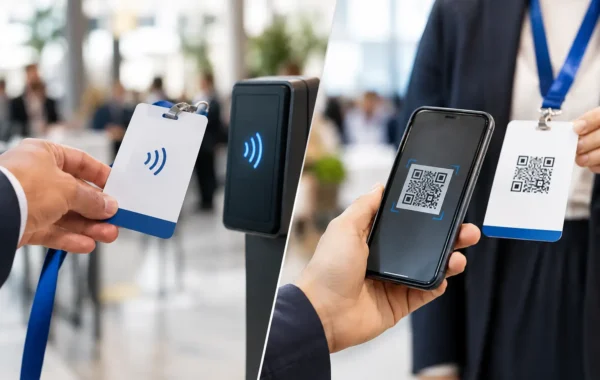

A badge tap can open a VIP lounge, capture a lead, confirm a meal selection, or trigger a personalized brand interaction. Yet choosing between NFC versus RFID is not simply a technology decision. It affects your attendee journey, hardware layout, credential design, data capture, onsite staffing, and the level of control your event team needs.
For corporate events, exhibitions, employee programs, and visitor-management deployments, the better option depends on what must happen at each touchpoint. NFC is built for close, intentional interactions. RFID is a wider family of technologies that can support everything from fast access validation to long-range asset tracking. The strongest deployments often use the technology that fits each operational moment rather than forcing one credential to do every job.
NFC Versus RFID: The Core Difference
RFID, or radio-frequency identification, is an umbrella term for technologies that identify tagged items using radio waves. RFID systems operate across several frequency ranges. Low-frequency RFID is often used for basic access credentials. High-frequency RFID is common in cards and wristbands. Ultra-high-frequency RFID can read tags from much farther away, making it useful for inventory, equipment, and high-volume tracking applications.
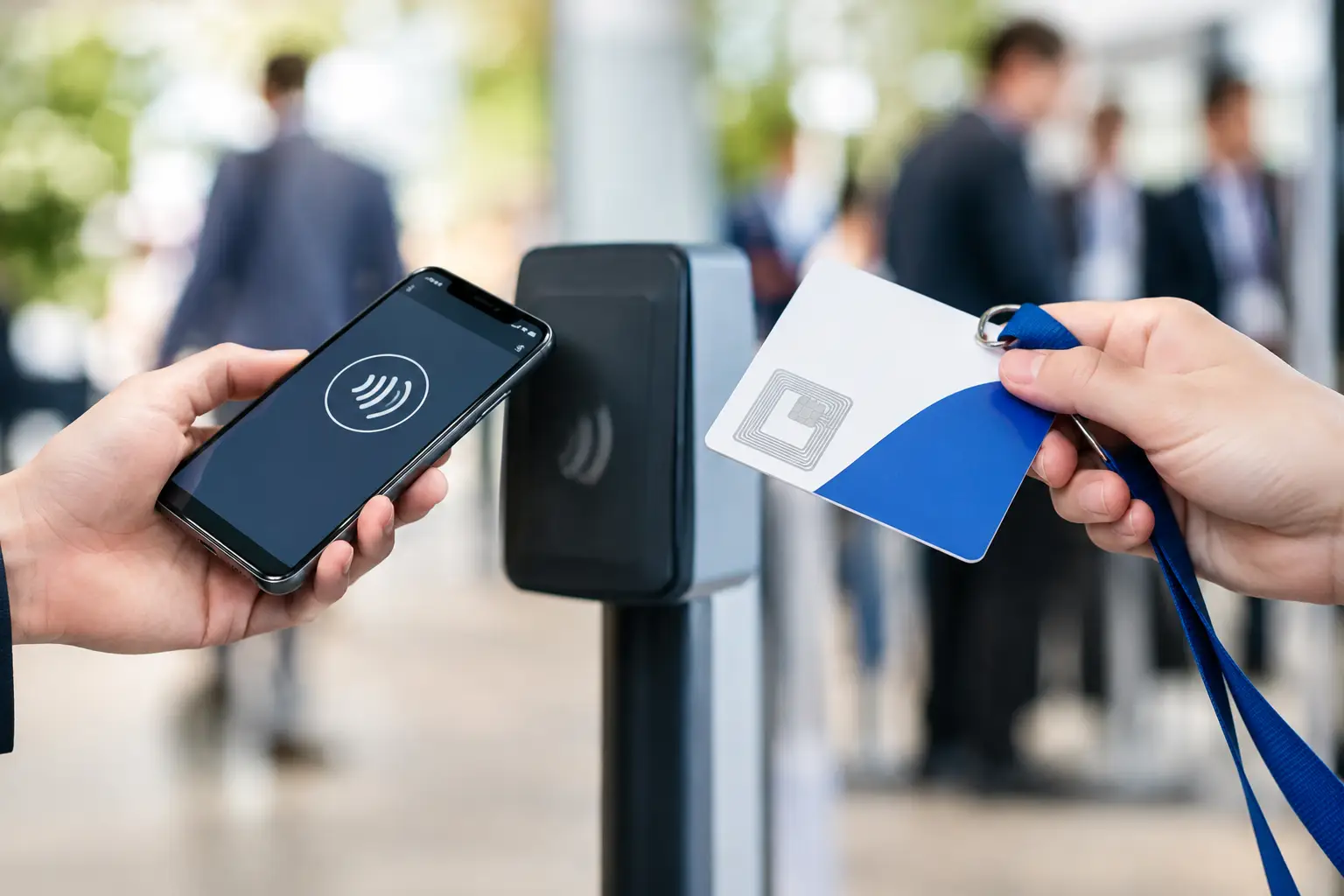
NFC, or near-field communication, is a type of high-frequency RFID technology. It operates at 13.56 MHz and is designed for very short-range communication, usually requiring a tap or near-tap. That limited range is intentional. It gives users a clear action: place the badge, card, wristband, or smartphone against the reader.
The practical distinction is simple. RFID can be configured for a range of reading distances and operational requirements. NFC prioritizes close-proximity interaction and works naturally with many modern smartphones. An NFC credential is RFID-based, but not every RFID solution is NFC.
Where NFC Performs Best at Events
NFC is particularly effective when an attendee should make a deliberate choice. Think of a sponsor activation where guests tap a branded card to receive product information, enter a competition, collect digital content, or opt in to a follow-up. The physical gesture is easy to understand and gives the participant confidence that an interaction has taken place.
Because NFC is supported by many phones, it can also reduce dependence on dedicated scanners for selected experiences. A guest can tap an NFC-enabled product display, table tent, badge, or printed invitation with their phone. For marketing teams, this creates a useful bridge between physical branding and digital engagement without asking attendees to scan a visible QR code.
NFC is also well suited to controlled access points where a close tap is acceptable. VIP areas, staff-only doors, meeting rooms, and hospitality lounges can benefit from the clear confirmation of an intentional credential read. For employee IDs and membership cards, NFC provides a premium, familiar experience while keeping the interaction close to the reader.
There is a trade-off. NFC is not designed for high-speed hands-free throughput. If hundreds of guests arrive at a conference entrance within a short window, asking every person to position a card carefully at a reader can create avoidable friction. The workflow, reader placement, and staffing plan matter as much as the chip inside the badge.
Where RFID Makes Operations Faster
RFID is the better fit when speed, distance, or batch reading is the priority. At a busy event entrance, an RFID access-control system can validate credentials rapidly as attendees pass through a managed checkpoint. Depending on the RFID type, reader configuration, and credential orientation, the system may allow a faster flow than a deliberate NFC tap.
For exhibitions and large conferences, RFID can support access zoning, session attendance, cashless or entitlement-based redemption, and equipment tracking. A staff member can confirm whether an attendee is authorized for a specific area without manually checking printed information. This improves control while preserving the polished experience expected at premium corporate events.
Ultra-high-frequency RFID is especially valuable behind the scenes. It can help identify equipment cases, rented tablets, printers, displays, lanyard stock, or branded merchandise as items move through staging, delivery, and return. It is not generally the first choice for a smartphone-led attendee engagement campaign, but it can be highly effective for logistics where read distance matters.
RFID does require careful planning. Reader coverage, antenna placement, tag material, nearby metal, liquids, dense crowds, and overlapping read zones can all influence performance. A fast credentialing system is only fast when its physical environment has been tested and its software rules are configured correctly.
Choose Technology by Touchpoint, Not by Trend
A useful event plan starts with the attendee journey. Registration, entry, session rooms, sponsor areas, dining, and post-event follow-up may each require different interactions. The question is not whether NFC or RFID is more advanced. The question is what action you need the attendee, staff member, or system to complete at that moment.
For example, a product launch may use NFC-enabled invitation cards for a branded pre-event RSVP experience. At the venue, RFID badges can manage rapid access through entry lanes and verify admission to a private reveal. Inside the experience zone, NFC touchpoints can invite guests to save content or register interest in a featured product. One credential strategy can support both operational control and meaningful engagement.
For a smaller executive gathering, NFC alone may be the right answer. A short guest list, controlled arrival times, and a premium hosted setting make tap-based check-in practical. The same NFC card can grant lounge access and connect guests to personalized content. Adding a long-range RFID layer would introduce cost and configuration without creating a stronger outcome.
For a large trade show, RFID may carry more of the operational load. Exhibitor access, staff credentials, zone permissions, lead capture, and high-volume check-in all benefit from a well-configured reader network. NFC can still add value at selected brand activations where phone compatibility and deliberate opt-in are central to the campaign.
Credential Design Is Part of System Performance
A technology-enabled badge is not merely a printed card with a chip hidden inside. Its format, material, encoding, visual hierarchy, and attachment method shape how it performs onsite. A premium PVC card offers durability and a professional finish for access, employee identification, and repeat-use programs. A printed badge with an encoded inlay may be more appropriate for a one-day conference where speed of production and visible attendee information are priorities.
Reader behavior must also be considered during design. If attendees wear credentials on lanyards, they need enough freedom to bring the badge close to an NFC reader. If RFID readers are installed at an entrance, the chip position and badge orientation should be tested against the intended equipment. Metallic finishes, thick holders, and stacked cards can affect read reliability.
Visual branding still matters. Attendees need to identify names, roles, access categories, and event information at a glance. The best credential programs combine secure encoding with color-coded design, clean data formatting, and rigorous print quality control. Technology should not compromise brand consistency, and branding should not interfere with the credential’s function.
Security and Data Require Deliberate Design
Neither NFC nor RFID is automatically secure simply because it is contactless. Security depends on the chip type, encryption options, reader configuration, access-control rules, backend platform, and operational process. A simple serial-number system may be adequate for low-risk attendance tracking, while employee access, VIP hospitality, or sensitive visitor data may require stronger authentication and carefully controlled permissions.
Event teams should also decide what data belongs on the credential and what remains in the registration platform. Storing less information directly on a card can reduce exposure if a badge is lost. The reader can use a unique identifier to retrieve the appropriate record, apply access rules, and create an audit trail.
For lead capture, consent should be clear. A badge tap at a sponsor booth should communicate whether it shares contact details, records an interaction, or opens a digital experience. Transparent design protects attendee trust and gives marketing teams cleaner, more actionable data after the event.
Build the Deployment Around Real Conditions
The most reliable NFC and RFID programs are designed before badges reach the printer. That means confirming attendee volumes, peak arrival windows, credential types, access zones, reader locations, network requirements, fallback procedures, and the onsite support model. A pilot test with the actual badge stock, encoded chips, readers, and software configuration can reveal issues that a desk-based plan will miss.
For demanding corporate environments, Smart Track Zone can align card encoding, badge production, registration workflows, reader hardware, branded touchpoints, and onsite technical support within one coordinated deployment. This avoids the familiar problem of separate vendors treating printing, access control, and event technology as unrelated tasks.
Choose NFC when intentional close-range engagement or smartphone interaction is the priority. Choose RFID when throughput, range, tracking, or large-scale access control sets the requirement. When the event needs both, design the credential and infrastructure around the journey your guests should actually experience – then test every touchpoint before doors open.