

A corporate event rarely fails because the original idea was weak. It fails when registration opens late, branding arrives with inconsistent colors, a kiosk is not configured for the venue network, or the onsite team lacks a clear escalation plan. How an expert event management company turns ideas into reality comes down to controlling these details before guests ever see them.
For corporate planners, marketing teams, and exhibition organizers, the goal is not simply to create an impressive room. It is to deliver a reliable guest journey that reflects the brand at every point: invitation, arrival, check-in, badge collection, wayfinding, engagement, and follow-up. That requires much more than a printer, a rental device, or a creative concept. It requires integrated execution.
How an Expert Event Management Company Turns Ideas Into Reality
An experienced event partner begins by translating an ambition into operating requirements. A product launch may need rapid VIP registration, branded touchscreen experiences, and controlled access to a private demonstration zone. A large conference may require high-volume badge production, multiple check-in lanes, clear digital wayfinding, and a technical team ready to resolve issues in real time.
The concept comes first, but it cannot remain abstract. The event team asks practical questions early: How many guests are expected at peak arrival? Which data fields must appear on each credential? Will badges include QR codes, RFID, or NFC encoding? Where will power, internet connectivity, and equipment storage be available? Which elements must meet brand approval before production begins?
This discovery stage protects both the experience and the budget. Not every event needs a complex self-service check-in environment, and not every attendee needs an encoded credential. The right solution depends on attendee volume, venue layout, security requirements, agenda structure, and the level of engagement the organizer wants to create. Expert planning avoids overengineering while ensuring that no critical touchpoint is left to chance.
Turning a Brief Into a Working Event System
The strongest event environments are designed as connected systems rather than separate purchases. Registration software, badge printers, kiosks, screens, lanyards, printed collateral, and onsite support should operate as one coordinated deployment.
Registration and check-in designed around real arrival patterns
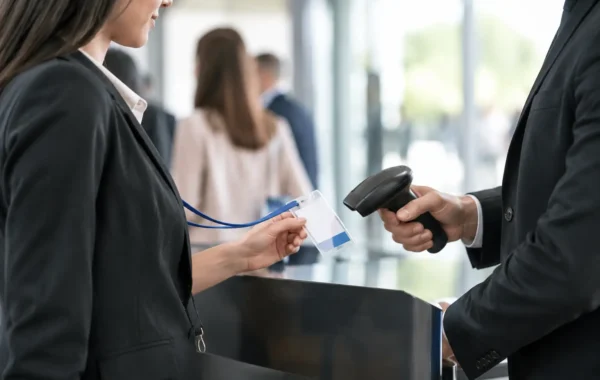
Registration is where operational quality becomes immediately visible. A polished stage or premium exhibition stand cannot compensate for a crowded entrance and long queues. An event management company reviews anticipated arrival windows, attendee categories, VIP requirements, and exception handling before selecting the right check-in model.
For some corporate events, staffed registration desks supported by onsite badge printing provide the needed control. For others, self-service kiosks reduce pressure during peak periods and give attendees a faster arrival experience. A hybrid setup can be particularly effective when VIP guests require personal handling while general attendees use QR-based self-check-in.
The technology must be configured, tested, and staged before deployment. That includes registration fields, badge templates, access rules, scanner settings, device charging, network planning, and contingency procedures. A system is only as effective as its preparation. When a guest arrives with a corrected name, a missing registration record, or a different access requirement, the onsite team needs a fast, defined response.
Brand consistency that survives production
Corporate branding is often treated as an aesthetic layer added at the end. In reality, it is part of event infrastructure. The badge in an attendee’s hand, the lanyard around their neck, the welcome screen at reception, and the directional signage across the venue all communicate the same standard of quality.
An expert provider converts brand guidelines into production-ready files and proofs. This process verifies logos, color values, typography, variable attendee data, QR placement, and finishing details before materials go into full production. It also accounts for the physical realities of the item. A logo that works on a wide presentation screen may need a different treatment on a PVC card, a compact name badge, or a narrow exhibition lanyard.
This is where integrated print and event capability matters. Secure PVC ID cards, attendee badges, membership cards, personalized merchandise, and premium corporate gifts should be produced with the same attention to color, legibility, and durability as the wider event environment. Rigorous quality control prevents the familiar last-minute problems of misaligned names, unreadable codes, inconsistent colors, or insufficient quantities.
Hardware staging before the venue doors open
Equipment is not ready simply because it has been delivered. Badge printers, laptops, scanners, touchscreen kiosks, digital signage, and networked devices must be staged as a working environment. Cables need to be managed safely. Devices require power planning. Screens must be positioned for visibility without obstructing guest movement. Printers need tested media, supplies, and backup capacity.
A specialist team also considers the venue itself. Hotel ballrooms, exhibition halls, outdoor activations, and corporate offices all create different technical conditions. Internet performance, loading access, room dimensions, lighting, furniture placement, and building restrictions can change the implementation plan. In the UAE and Saudi Arabia, where large-scale corporate gatherings and exhibitions often operate on compressed timelines, these checks are particularly valuable.
The Onsite Team Is Part of the Product
Technology does not remove the need for people. It raises the importance of having the right people onsite. A specialized onsite team provides the operational confidence that corporate buyers need when schedules are fixed, senior guests are arriving, and every visible touchpoint carries brand implications.
Before doors open, the team verifies registration flows, prints test badges, validates scanner behavior, checks screen content, and confirms device readiness. During the event, they monitor supply levels, support staff at check-in points, troubleshoot hardware, and respond to attendee exceptions without disrupting the wider experience.
This is also where accountability matters. When the same provider is responsible for technology configuration, rental hardware, branded print production, delivery, and onsite support, there is less room for handoff errors. The organizer has one operational partner coordinating the complete digital infrastructure rather than trying to reconcile several vendors under event-day pressure.
Smart Track Zone applies this model by combining event technology, credential production, visual branding, equipment staging, and technical support into one managed deployment. The result is not merely a collection of event services. It is a controlled environment built around the organizer’s guest journey and brand requirements.
Planning for What Can Change
No event plan is immune to change. Guest lists grow, speakers arrive with additional staff, a sponsor requests an updated logo, or an attendee’s credential needs a last-minute access adjustment. Expert event management is not about pretending these changes will not happen. It is about building processes that absorb them without compromising the event.
Contingency planning should cover backup equipment, additional print consumables, replacement badges, approved artwork versions, technical contacts, and clear decision-making authority. The scale of the contingency depends on the event. A small leadership meeting may only need a backup printer and a controlled guest list. A multi-day exhibition may require redundant devices, extended onsite coverage, and structured reporting across several zones.
The trade-off is straightforward: additional resilience can increase preparation and rental costs, but it reduces the risk of visible disruption. For high-profile launches, major conferences, and access-controlled events, that investment is often justified. The correct level of support is determined by the cost of failure, not by the length of the equipment list.
Measure the Experience, Not Just the Setup
A successful event deployment should be evaluated against operational outcomes. Were guests checked in quickly? Did badges scan correctly? Could visitors find the right session or zone? Did every printed and digital touchpoint represent the brand with absolute consistency? Were issues resolved before they became visible to attendees?
These questions help event teams improve future programs and make better decisions about registration design, credential technology, staffing, and branded materials. They also shift the conversation away from individual products toward business impact: stronger engagement, clearer organization, better data capture, and greater confidence from guests and stakeholders.
The idea may begin with a campaign objective, an event theme, or a packed brief from the marketing team. Its reality is created in the details: a tested check-in flow, an accurately printed badge, a correctly configured kiosk, and a prepared team that knows exactly what to do when the doors open.