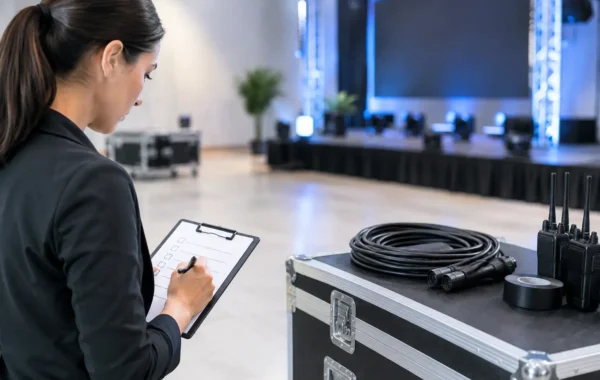
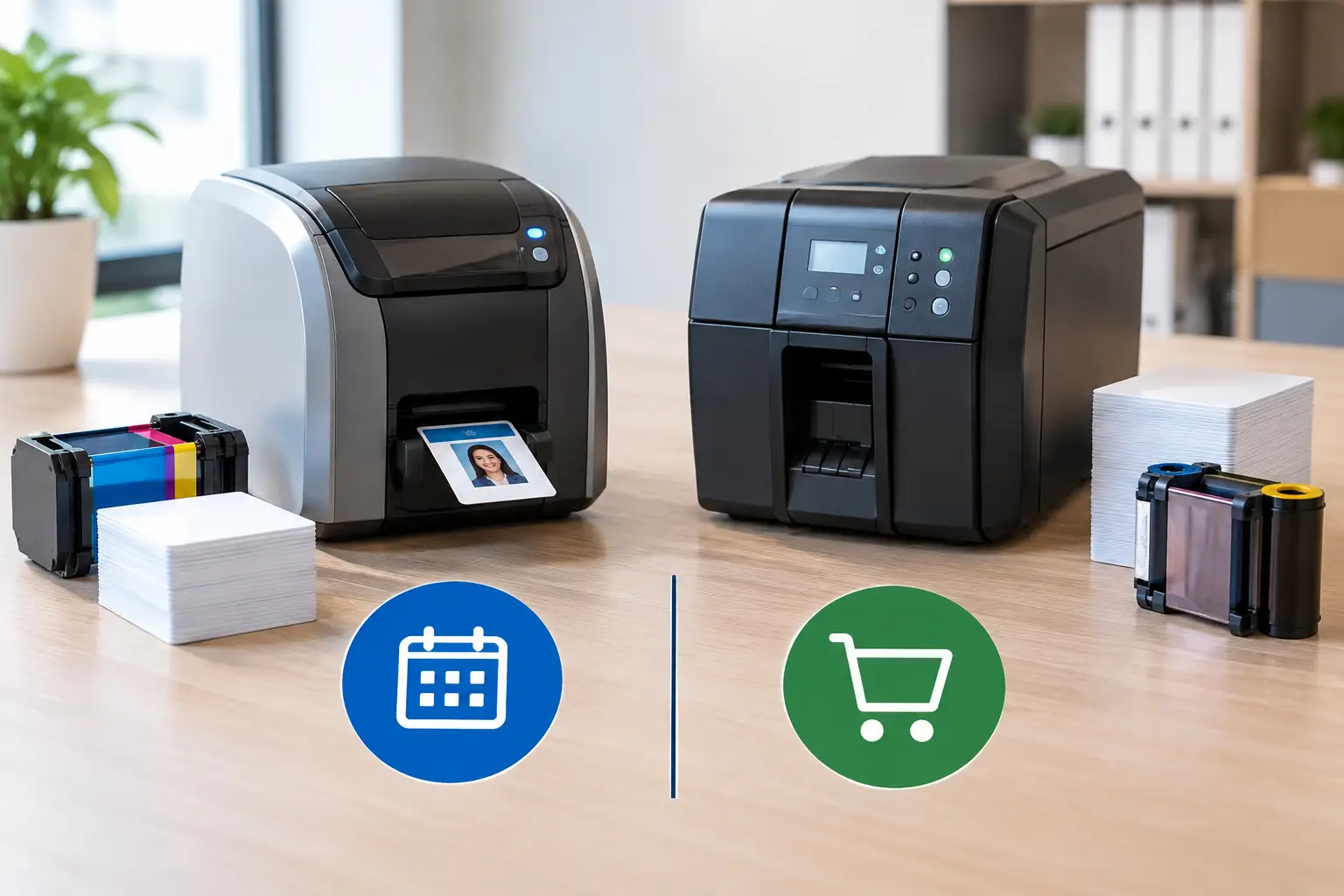

A badge printer can look like a small line item until the registration desk opens and 600 attendees arrive within the same hour. At that point, the badge printer rental vs buying question is not only about the equipment price. It is about how much your team spends to keep check-in moving, credentials accurate, and your event brand intact when timing is tight.
For most one-off events, short conference programs, and variable attendee volumes, renting is usually the lower-cost and lower-risk option. Buying becomes financially attractive when badge production is frequent, predictable, and supported by trained internal staff. The right answer depends on the total operating cost, not the printer’s sticker price.
Badge Printer Rental vs. Buying: The Real Cost Comparison
A direct comparison between a rental quote and a printer purchase price can be misleading. A purchased printer is an asset, but it also creates responsibilities that do not disappear after the event: consumables, maintenance, storage, configuration, troubleshooting, software compatibility, and depreciation.
A rental package is often priced around the specific event requirement. It may include the printer, pre-tested ribbons and cards, badge design setup, registration or printing software, delivery, collection, and technical support. Some providers also supply a backup unit, check-in laptops, scanners, kiosks, and onsite personnel. That bundled scope changes the calculation substantially.
| Cost area | Renting for an event | Buying a printer | | — | — | — | | Upfront payment | Lower, project-based expense | Higher capital expense | | Consumables | Often planned into the event scope | Must be ordered, stored, and monitored | | Technical support | Can be included onsite | Internal team or paid service call | | Backup equipment | May be supplied as part of the deployment | Requires a second unit or contingency plan | | Software and setup | Can be configured for the event | May require licenses and internal setup time | | Storage and maintenance | Provider responsibility | Your responsibility between events |
The purchase price can still win over time, but only when the equipment is used often enough and your team can operate it confidently. A printer sitting in storage for ten months is not producing value. It can also become a problem when a driver update, worn printhead, or expired card stock is discovered on the morning of an important event.
When Renting Is Usually Cheaper
Rental is generally the smarter commercial decision for annual conferences, exhibitions, product launches, awards programs, roadshows, and internal events that occur a few times per year. These projects often need more than a printer. They need a working credential environment: attendee data imported and validated, badges designed to brand guidelines, QR codes or RFID/NFC credentials encoded where required, and a clear check-in workflow.
A managed rental avoids paying for capacity you will not use. A 150-person executive forum may require one desktop printer and a trained registration operator. A 2,000-attendee exhibition may require multiple print stations, staff check-in counters, scanners, queues, backup hardware, and a dedicated technical lead. Renting allows the hardware layout to scale to the event rather than forcing every event into the limits of one owned device.
It is also less expensive when speed matters. If an event team has to spend two working days learning unfamiliar printer settings, testing badge templates, resolving encoding issues, and sourcing emergency supplies, the apparent savings of ownership can disappear quickly. The true cost includes staff time and the operational impact of a delayed registration desk.
Rental creates particular value for events with variable design and security needs. One event may use standard name badges with lanyards; the next may require color-coded access levels, durable PVC cards, sponsor branding, QR-enabled sessions, or RFID access control. A specialist provider can stage the appropriate technology and production method for each format rather than asking a single printer to handle every requirement.
When Buying a Badge Printer Makes Financial Sense
Buying can be the better long-term choice for organizations that print credentials continuously. HR departments issuing employee IDs, membership teams producing cards every week, hospitality operators managing frequent visitor passes, and large venues with regular in-house events may reach a point where ownership is justified.
The strongest case for purchase has three conditions: predictable recurring volume, an internal operator who owns the process, and a clear maintenance plan. If those conditions are present, the purchase cost can be spread over hundreds or thousands of cards. The per-badge cost may then fall below repeated rental fees.
For example, an organization running monthly training programs with 100 participants each may use the same card stock, badge format, and check-in process throughout the year. With a trained administrator, dependable software configuration, and readily available consumables, owning a printer can provide control and faster turnaround.
However, buying should not be confused with complete independence. Ask whether the printer supports your planned card type, print volume, and security requirements. Check the cost of ribbons, cleaning kits, replacement printheads, software licenses, encoding modules, and service support. Confirm who will manage templates, data imports, privacy controls, and equipment testing before each event.
Calculate the Break-Even Point Beyond the Printer Price
A practical break-even calculation starts with the total annual cost of ownership. Add the printer purchase, shipping, tax, software, supplies, maintenance, storage, staff training, and an allowance for downtime or replacement. Then compare that figure with the annual cost of rental projects that provide equivalent equipment and support.
The important word is equivalent. Do not compare buying one printer with renting a fully staffed registration desk that includes two printers, badge stock, data setup, delivery, a backup unit, and onsite troubleshooting. Compare like for like.
A useful internal question is: if our primary printer stops printing during peak arrival, who fixes it within minutes? If the answer is uncertain, the cost of operational risk belongs in the ownership calculation. At a high-profile event, a visible registration queue can affect attendee confidence before the program even begins.
You should also account for utilization. If a $3,000 printer supports only two small events annually, it may take years to justify its cost, before maintenance and supplies. If the same printer is used every business day for employee IDs or visitor credentials, the economics look very different.
Support Is Often the Deciding Cost
For corporate event teams, the most expensive failure is rarely a damaged printer. It is a broken attendee experience. A badge printed with the wrong name, an unreadable QR code, a missing access category, or a check-in station that cannot sync with registration data can create delays across the venue.
That is why event rentals should be evaluated as an operating service, not simply equipment hire. Clarify what the provider will configure before delivery, what consumables are included, how badge files are approved, whether a backup printer is available, and whether a specialized onsite team can respond during registration hours.
Smart Track Zone approaches badge printing as part of a complete event infrastructure plan. Hardware staging, software configuration, branded credential production, and onsite technical support can be coordinated around the actual guest journey. This gives planners one accountable team for both presentation quality and operational performance.
Choose the Model That Matches Your Event Calendar
Rent when your event schedule is occasional, your attendee counts vary, or the project demands high-stakes onsite support. Buy when your badge output is continuous, standardized, and managed by a capable internal team with a realistic plan for supplies and maintenance.
For many organizations, the best approach is not permanent loyalty to either model. Own equipment for everyday credentials, then rent additional printers, self-service kiosks, scanners, or staffed check-in stations for major events. That hybrid model protects budget discipline while giving large-scale programs the capacity and technical assurance they require.
Before approving either option, map the attendee journey from data upload to badge collection and ask where your team needs certainty. The cheapest printer is not always the lowest-cost decision. The right setup is the one that keeps registration controlled, credentials accurate, and your brand presented exactly as planned.