
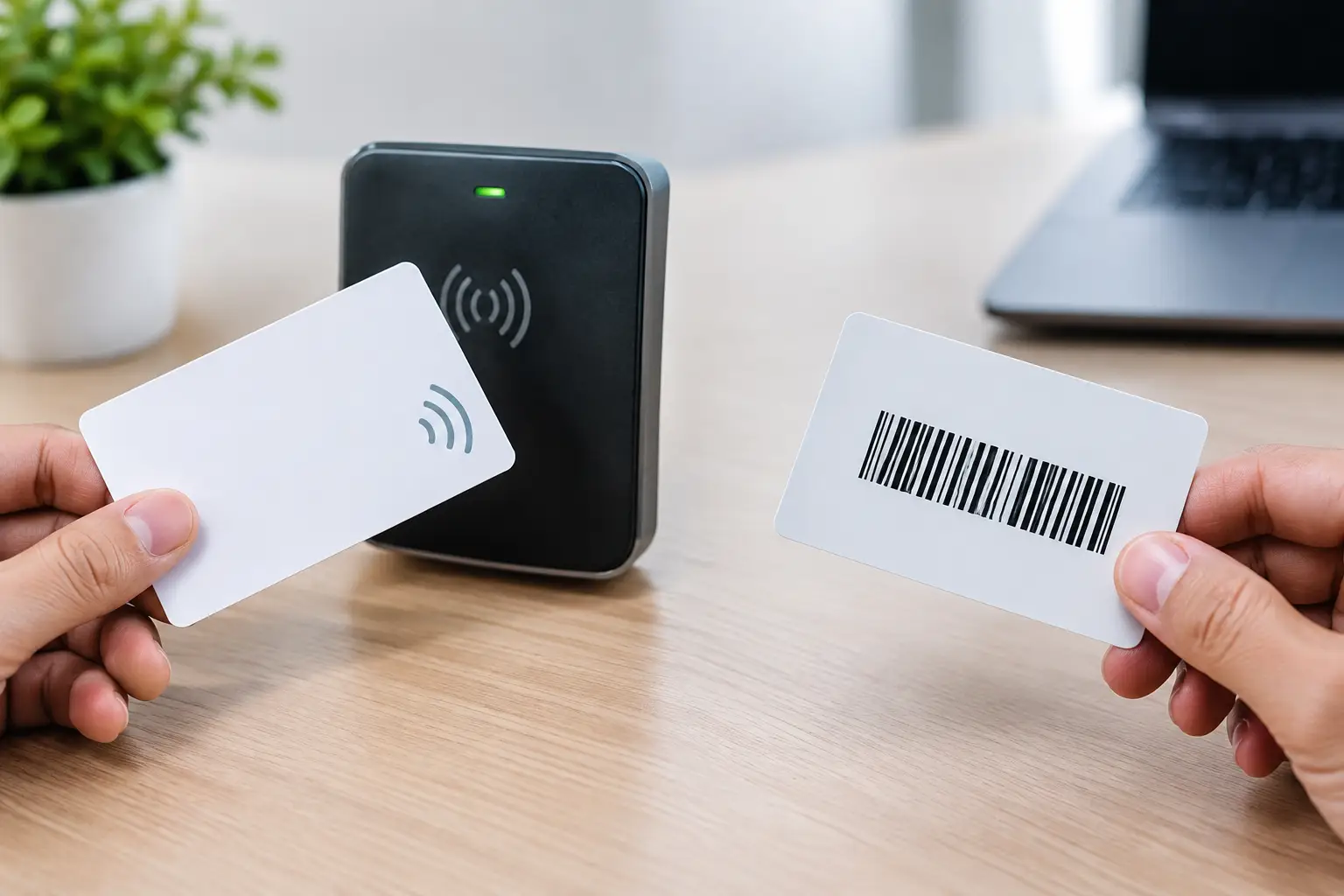

A registration queue can reveal the difference between RFID cards versus barcode cards in minutes. One attendee presents a badge to a scanner and moves on. Another must hold the credential at the right angle, wait for the code to read, or try again. For a small internal gathering, that delay may be acceptable. For a high-volume conference, exhibition, or controlled-access environment, it can shape the first impression of the entire event.
Both technologies can support professional credentials, attendance tracking, access control, and brand-consistent PVC cards. The right choice depends less on which technology sounds more advanced and more on how guests will move through the experience, what data the team needs, and how much operational control the program requires.
RFID Cards Versus Barcode Cards at a Glance
Barcode cards store an identifying number in a printed linear barcode or QR code. A camera or laser scanner reads the visible code and sends that number to registration, access, or visitor-management software. The system then confirms the attendee record, admission status, or relevant action.
RFID cards contain an embedded chip and antenna. When brought within range of a compatible reader, the card transmits its unique identifier without a direct visual scan. NFC cards are a closely related form of RFID, typically designed for very short-range interactions with phones, tablets, or NFC readers.
The essential operational difference is line of sight. Barcode credentials must be visible and sufficiently well printed to be scanned. RFID can be read through the card body, a badge holder, or often a lanyard presentation, depending on reader configuration. That difference affects speed, hardware requirements, card cost, and the types of attendee interactions an organizer can design.
Where Barcode Cards Make Practical Sense
Barcode cards are a strong choice when the main requirement is clear identification with a straightforward digital check-in record. They are economical to produce, quick to personalize, and compatible with a wide range of camera-based scanners, mobile devices, and registration platforms.
For a training session, staff visitor pass, corporate open day, or smaller invitation-only event, a printed QR code can provide reliable check-in with minimal infrastructure. It also gives each credential a practical fallback: event staff can visually verify the attendee name, company, and badge category if a device or network issue needs attention.
Advantages of barcode credentials
Barcode cards generally have lower unit costs because there is no embedded chip or encoding step. Production is also flexible. The same card layout can carry a QR code for check-in, a printed schedule, sponsor branding, color-coded access levels, and attendee details.
They work particularly well where scanning happens at a single, staffed point. A registration host can guide the attendee, manage exceptions, and rescan when needed. This makes barcode systems a sensible option when budget control matters and the expected arrival rate is manageable.
Barcode limitations to plan for
A barcode is only as reliable as its print quality, placement, and visibility. Scratches, glare from lamination, poor contrast, folds in paper badges, or a phone screen set at low brightness can slow scanning. At busy entrances, guests may also turn badges the wrong way or present them too far from the reader.
Barcode credentials are easier to copy because the data is visible. A screenshot of a QR code or a photograph of a printed badge may be enough to create a duplicate unless the software applies controls such as single-entry rules, real-time validation, and staff review. For basic attendance management, this may be an acceptable trade-off. For restricted zones or premium guest programs, it requires closer consideration.
When RFID Cards Deliver More Control
RFID is designed for environments where throughput, repeat interactions, and controlled access matter. A correctly configured reader can recognize a credential with a tap or close presentation, reducing the need for attendants to position every card precisely. This is valuable at conference entrances, exhibition halls, VIP areas, staff-only zones, meal access points, and multi-session programs.
The benefit is not simply speed. RFID can turn each reader location into a data point. An organizer can record entry to a keynote room, access to a hospitality lounge, equipment issue and return, or engagement at selected activations. The quality of that data still depends on software setup, reader placement, and a clearly defined operational process.
Faster movement at high-volume touchpoints
At peak arrival times, small delays multiply quickly. RFID helps reduce friction when hundreds or thousands of guests arrive within a narrow time window. It can also support self-service check-in kiosks, where attendees tap a credential and receive a confirmation, badge reprint instruction, or personalized event direction.
For events with several controlled points, RFID avoids asking guests to repeatedly locate and align a barcode. That produces a more polished experience, especially when the credential is part of a branded lanyard and badge system.
RFID security is stronger, but not automatic
RFID cards can support unique serial numbers, sector-based data, and more advanced security options depending on the chip type and access-control platform. Unlike a visible barcode, the information is not immediately available to someone looking at the card.
However, RFID is not a guarantee of security by itself. A low-security chip, poorly configured reader, or inactive credential database can create weak points. Programs handling restricted access, employee identities, payments, or sensitive visitor records should define whether cards need encryption, authentication, anti-passback controls, or immediate deactivation after loss. Security should be designed into the credential workflow, not added after cards are printed.
Cost Is More Than the Price of the Card
Barcode cards usually cost less per credential, but the total project cost should include scanners, registration devices, software integrations, staffing, reprints, signage, and the impact of slower peak-time processing. A lower-cost badge that creates a congested registration desk may not be the lower-cost operational choice.
RFID cards cost more because they require compatible chips, encoding, reader hardware, testing, and technical configuration. The investment becomes more compelling when the program needs multiple access points, measurable engagement, frequent badge interactions, or a premium attendee journey.
Reusable RFID cards can also make sense for workplaces, membership programs, hospitality teams, and recurring events. They need a disciplined collection, cleaning, data reset, and redeployment process. For one-time conferences, organizers often prioritize durable branded cards or RFID-enabled badges that can remain with attendees as a keepsake.
Choosing the Right Card for Your Program
Start with the attendee journey rather than the card technology. Map every place a person needs to register, enter, interact, collect an item, or receive a service. Then ask what must happen at each point: simple identity confirmation, access validation, attendance capture, lead capture, or personalized content delivery.
Barcode cards are often the right fit when the event has one or two staffed check-in points, low to moderate traffic, basic attendance needs, and a cost-sensitive credential plan. They also work well for visitor badges and temporary ID programs where visibility and easy replacement are priorities.
RFID is typically the better fit when a program has high attendance volume, repeated access checks, multiple zones, self-service kiosks, or meaningful reporting requirements. It is also a strong option when the card needs to support a more controlled experience across registration, session entry, hospitality, and brand activations.
Do not separate design from deployment
The card should be designed around the technology, not treated as a final print decision. Barcode size, quiet zone, contrast, and finish directly affect scan performance. RFID card choice affects reader compatibility, print method, chip placement, encoding procedures, and on-site testing.
A complete credential plan should confirm the card stock, visual artwork, attendee data fields, encoding format, software connection, reader layout, contingency process, and onsite support responsibilities before production begins. This is where an integrated event technology partner can prevent common gaps between the registration system, printed badge, hardware staging, and event-floor execution.
For corporate events and visitor programs, the best credential is the one that makes the correct action easy for every guest and every staff member. Choose barcode cards when simplicity is enough. Choose RFID when movement, measurement, and access control need to perform at a higher level – then test the full workflow before the doors open.